

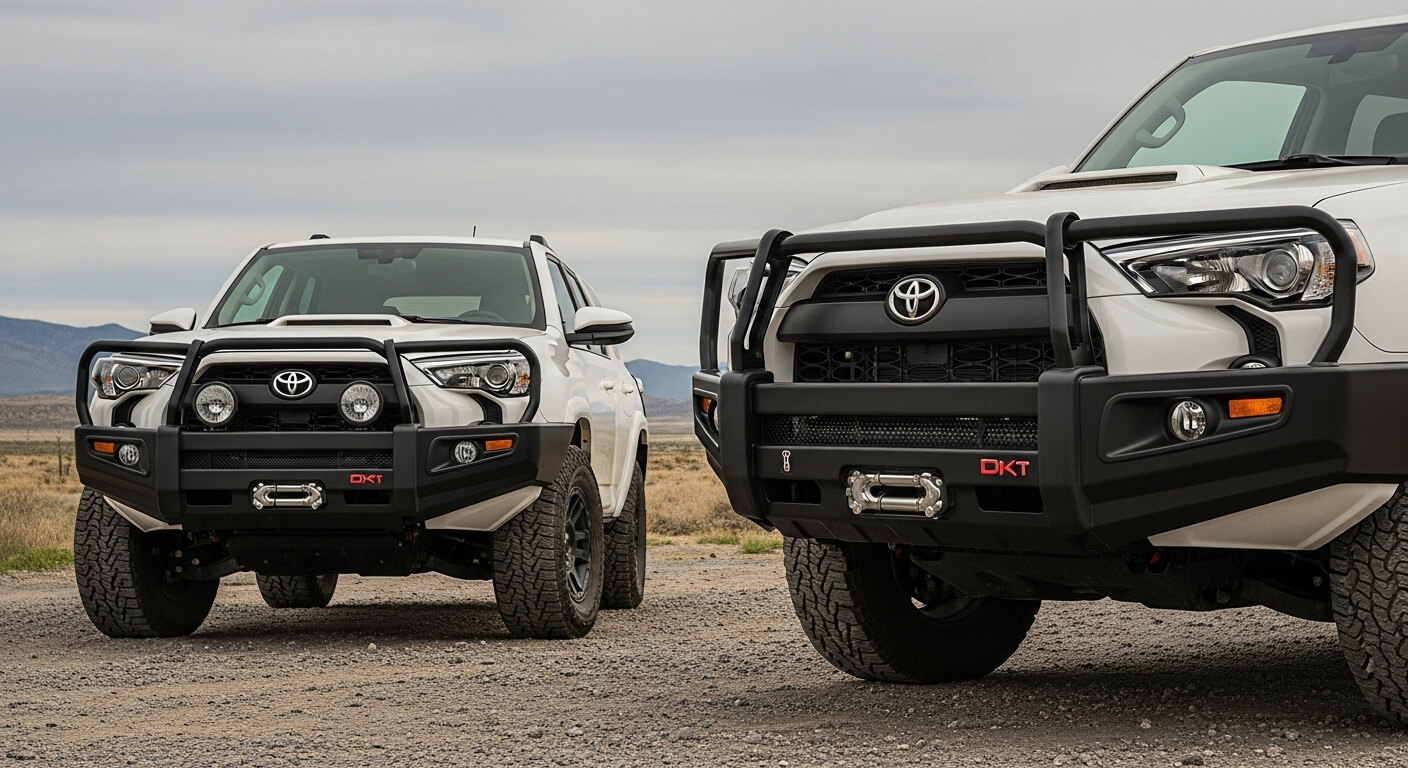
Finding the right bull bar for a Toyota 4Runner sounds easy until it really isn’t. You start with protection in mind, then somehow end up worrying about looks, stance, sensor clearance, that weird feeling when something just doesn’t belong. The 4Runner already has a personality, kind of blunt, kind of confident, and a bull bar can either respect that or completely ruin it before your first coffee of the day. You want something that adds front-end defense without shouting for attention, without scraping every driveway, without turning daily driving into a compromise you didn’t sign up for. After digging through fitment notes, long-term owner chatter, and the stuff people only admit after a year of use, one option keeps floating back to the surface as the sensible pick. The Westin Ultimate Bull Bar doesn’t overplay its role. It sits right, feels solid, and protects without trying to prove anything, which, honestly, is exactly the point.
Best 5 Bull Bars for Toyota 4runner
01. KUAFU 3” Bull Bar

You don’t end up looking at a 3-inch bull bar like this unless you’ve already decided the front of your truck takes a little too much abuse. Rocks kicked up on back roads, brush leaning in where it shouldn’t, that one parking lot curb that feels personal. The KUAFU 3″ Bull Bar feels built for exactly that kind of reality. Thick tubular steel, not the skinny stuff that flexes if you stare at it wrong, and a black powder coat that looks like it expects dirt, rain, and neglect. On rigs like the Toyota 4Runner (1996–2004) and similar off-road SUVs, it gives the front end a harder edge without screaming for attention. It just looks… ready. Especially once you start pairing it with LED light bars or auxiliary fog lights and suddenly the whole setup makes sense.
What I liked digging into is how uncomplicated it stays. The mounting brackets and hardware are included, no mystery parts, no late-night runs to the hardware store. If you’ve got basic tools and a bit of patience, this is a driveway install, not a saga. It’s not a full wraparound grille guard, and honestly that’s kind of the point. You still get easy access to the factory bumper, solid protection where it counts, and none of that bulky, overbuilt feel that turns daily driving into a chore. For someone who wants real front-end defense, a tougher look, and something that works Monday through Friday and still feels right on a weekend trail run, this bull bar lands in a comfortable, sensible spot without going overboard.
Pros
- Rugged 3-inch steel tubing with black powder coat
- Adds front-end protection against brush and light impacts
- Works well with off-road lights or auxiliary lighting
- Simple bolt-on installation with included hardware
- Enhances aggressive look on trucks and SUVs
Cons
- Not a full grille guard — coverage is limited to center area
- Powder coat finish can chip with heavy use
- Slight added weight up front may affect mileage slightly
02. Tyger Auto TG-GD6T60178 Front Bumper Guard
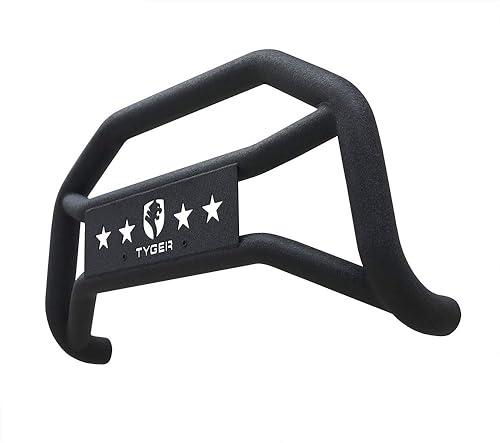
You don’t bolt on a front bumper guard like the Tyger Auto TG-GD6T60178 because you’re planning to ram through forests or play demolition derby in a grocery store lot. It’s more subtle than that. It’s about the little hits. Flying road junk. A misjudged parking stop. That brush scrape that sounds louder than it should. This guard shows up quietly tough. Built by Tyger Auto, it’s wrapped in a textured black finish that doesn’t panic every time it gets nicked. Scratches blend in. Dust doesn’t scream for attention. On trucks like the Toyota Tundra, Toyota 4Runner, Toyota Tacoma, or Nissan Titan, it actually looks like it belongs there, not some afterthought bolted on at midnight.
The install part is refreshingly uneventful. It lines up with factory mounting points, bolts on without cutting, drilling, or swearing at your truck for hours. Once it’s on, the steel feels planted, no hollow clang, no weird flex when you lean into it. It’s not pretending to be a full winch bumper or hardcore rock crawler armor, and that’s kind of the point. This is about daily protection, a tougher stance, and just enough shield to make highway miles and back roads feel less risky. Add a light bar if you want, keep it clean if you don’t. Either way, it gives your truck presence and protection without turning the front end into an overbuilt science project.
Pros
- Durable steel construction with textured black finish
- Bolt-on install — no drilling for most trucks
- Helps protect front end from light impacts and debris
- Works with LED light bars and extra driving lights
- Adds aggressive look to your truck or SUV
Cons
- Not a heavy-duty off-road bumper replacement
- Fitment must be checked carefully by year/model
- Painted surface may eventually show chips under rough use
03. ECOTRIC Bull Bar
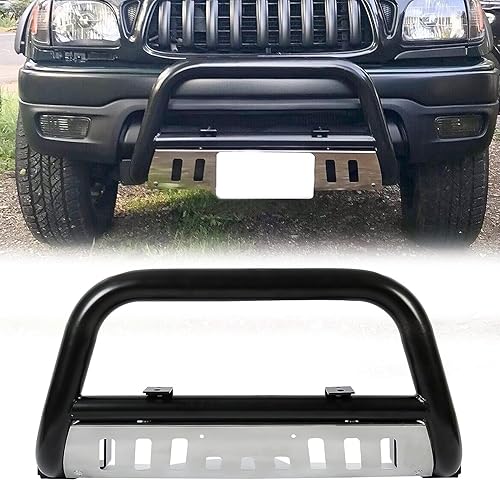
You don’t bolt a bull bar onto a Tacoma or 4Runner because you’re bored on a Saturday afternoon. It’s usually because trails aren’t polite, parking blocks jump out of nowhere, and brush doesn’t politely step aside when you’re easing through a narrow path. After poking around install photos, reading owner gripes that feel typed in frustration, and watching how these things age after mud, rain, and sun abuse, the ECOTRIC Bull Bar keeps coming up for a reason. It’s built from thick steel, finished in that no-nonsense black that hides scratches better than glossy paint, and it gives the front end of trucks like the Toyota Tacoma and Toyota 4Runner a kind of quiet toughness. Not screaming for attention, just standing there ready to take a hit from rocks, low branches, or the occasional “how did that happen” moment.
The install side of things matters more than brands admit, and this is where the ECOTRIC setup earns points. It’s a true bolt-on job, hardware included, no drilling, no cutting, no regret halfway through. Most people knock it out in a couple of hours, maybe longer if coffee breaks keep happening. The tubular layout also makes sense if you’re planning ahead, leaving room for auxiliary lights or an LED light bar when factory headlights start feeling a bit weak after dark. It’s not pretending to be a full replacement bumper or some extreme rock-crawler armor, and that’s kind of the point. The ECOTRIC bull bar lands in that middle ground where protection, looks, and price don’t fight each other, making it a smart pick for Tacoma and 4Runner owners who actually use their rigs instead of just talking about it.
Pros
- Durable steel construction with a rugged black finish
- Adds grille and headlight protection for daily driving and trails
- Bolt-on installation with included hardware
- Supports mounting auxiliary lights or LED bars
- Gives trucks a bolder, more aggressive front look
Cons
- Not a full bumper replacement for extreme off-road loads
- Adds weight that may slightly affect fuel economy
- Fitment can require careful alignment during install
04. TAC Modular Bull Bar

The TAC Modular Bull Bar isn’t aimed at the chrome-polish crowd or the “my bumper cost more than my truck payment” crowd either. It’s for people who actually use their truck, scrape through brush, misjudge parking blocks once in a while, and still want the front end to survive it all without emptying the wallet. The textured black steel finish feels intentional, not decorative, and that matters. On a Toyota 4Runner or similar trucks, it sits right where it should, protecting the grille and lower front end from flying rocks, trail debris, and those everyday road surprises nobody plans for. The look is aggressive, sure, but not cartoonish. More like the truck finally looks ready for what you actually ask it to do.
What really helps this bull bar earn its spot is how painless the install tends to be. The modular setup bolts directly to factory mounting points, no cutting, no welding, no staring at your truck wondering if you just made a mistake. It’s friendly to basic tools and average patience levels. A lot of owners end up adding LED light bars or auxiliary fog lights up top, which makes night drives, early-morning trail runs, or long highway slogs way less stressful. It’s not pretending to be a full replacement bumper with winch mounts and armor plates, and that honesty works in its favor. For anyone who wants meaningful protection, a tougher stance, and some upgrade freedom without blowing the budget, the TAC Modular Bull Bar lands in a pretty comfortable sweet spot.
Pros
- Heavy-duty steel construction with a textured black finish
- Modular bolt-on design for easier install
- Helps protect grille and front end on trucks, SUVs
- Looks rugged without overly flashy styling
- Works with aftermarket lighting like LED bars
Cons
- Not a full bumper with winch mounts
- Adds noticeable weight to front end
- Basic hardware and instructions can feel sparse
05. WESTIN 31-5615 E-Series Bull Bar
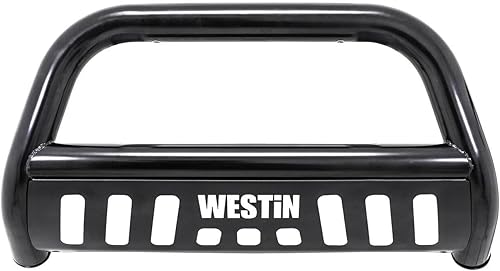
You don’t end up with the WESTIN 31-5615 E-Series Bull Bar because you were chasing drama or trying to turn your truck into some loud off-road statement. This one shows up when you’re tired of rock chips, brush scrapes, and that slow creep of front-end wear that happens just from driving like a normal human. Built from heavy-gauge steel with a textured black finish that doesn’t scream for attention, it’s the kind of front-end guard that looks like it belongs there. On trucks like the Ford F-150, Chevy Silverado, or GMC Sierra, it fits the factory bumper lines clean enough that nothing feels forced. Even the open-center design feels intentional, letting airflow move freely so your radiator isn’t quietly suffering while everything else looks tough.
What really makes it click is how straightforward it all stays. The mounting hardware lines up with factory brackets, no weird fabrication, no “almost fits” moments that ruin your weekend. Once bolted down, it feels planted, protecting the grille and front fascia from those everyday hits that never seem serious until you’re staring at a dent later. It also doubles nicely as a mounting base for LED pods or auxiliary lights, which comes in handy on dark back roads or early morning starts when visibility is questionable at best. If you want protection that works, looks right, and doesn’t turn your truck into a rolling accessory catalog, the Westin Automotive E-Series bull bar lands in that quiet sweet spot.
Pros
- Heavy-gauge steel construction with textured black finish
- Adds real front-end protection for trucks and SUVs
- Compatible with auxiliary lights or LED pods
- Straightforward bolt-on installation on factory mounts
- Tough look that complements rugged vehicles
Cons
- Steel weight ups the front mass, potentially affecting fuel economy
- Not a high-end off-road bumper substitute
- Light mounting hardware could be better quality
How to find the Best Bull Bars for Toyota 4runner
You look at a Toyota 4Runner long enough and it starts staring back. Big eyes. Confident jaw. Kind of daring you to do something reckless, or at least bolt something heavy onto its face. A bull bar creeps into your thoughts like that. Not urgent, not logical at first. Just there. I need protection. I want the look. I dont want to ruin what already works. That back and forth keeps looping.
This is not about slapping metal on for the sake of it. Or maybe it partly is, no shame there. But mostly it’s about not regretting the choice six months later when a parking lot tap costs four figures or when you realize your approach angle just got worse and nobody warned you properly.
Why a bull bar even makes sense on a 4Runner
The Toyota 4Runner already comes from a tough lineage. Body on frame. Proven suspension geometry. People take these things to places where cell signal quietly gives up. So the bull bar question feels almost personal. Are you adding insurance or adding noise.
Low speed impacts are boring until they happen. Insurance industry data keeps circling the same numbers, most urban vehicle collisions happen under 15 mph, a lot under 10 mph. Fender benders. Parking lot nonsense. That is exactly where a bull bar does its job, absorbing or deflecting instead of letting plastic and sensors take the hit. I learned that the hard way watching a shopping cart drift like it had a mission.
Off road, it’s less about smashing through things and more about misjudging rocks, ruts, animal strikes at dusk. A bull bar can give you that little buffer when your brain is tired but your wheels keep rolling.
But there’s a flip side and you feel it if you are honest. Weight. Front end sag. MPG shaving itself down by half a mile per gallon. Small numbers that add up over years. Nothing is free here.
Steel vs Aluminum
Steel feels obvious. Heavy. Reassuring. Cold in a way that makes you trust it. Most steel bull bars for the 4Runner sit in the 45 to 70 pound range depending on tubing thickness and add ons. That weight can be good for strength but it does ask more from your front suspension. Many owners end up pairing steel bars with upgraded springs without planning to.
Aluminum sounds fancy until you realize it is not weak, just different. Roughly 30 to 40 percent lighter than steel for similar designs. Less rust worry too. But aluminum transfers force differently, it bends sooner, absorbs in another way. Some people swear by it. Some don’t trust it because it doesnt feel serious enough. That part is emotional more than technical.
Powder coating quality matters more than material sometimes. A cheap coating chips. Then rust shows up quietly. I’ve seen bars that looked tired after one winter. And others that still looked stubborn after five years of salt and dirt. Same metal, different care.
Fitment
A bull bar that fits a Toyota 4Runner is not universal just because the box says so. Year matters. Trim matters. Sensor placement matters a lot more than marketing copy admits.
Modern 4Runners carry forward collision sensors, radar, parking sensors depending on trim. A poorly designed bar can block or confuse these systems. Some owners report warning lights popping up randomly after installs. Not always immediate, sometimes weeks later. That kind of problem ruins weekends.
Also airflow. Sounds boring until your transmission temps creep up during towing or slow trail work. Bars that sit too close or block the grille can affect cooling. Toyota engineered airflow carefully. Aftermarket parts need to respect that, but not all do.
Style vs clearance
There’s the tall loop bull bar that screams presence. And the lower profile nudge style that almost whispers. Both protect, just in different ways.
High loops offer more radiator and headlight protection, sometimes space for auxiliary lights. But they can reduce approach angle slightly. If you crawl over rocks often, that matters. Even an inch matters when gravity gets involved.
Low profile bars keep clearance better and look cleaner. But they protect lower fascia more than upper components. It becomes a choice between looks, function, and where you actually drive. Not where you imagine driving on a Sunday night scrolling photos.
I once chose based on looks alone and regretted it the first time I scraped on a trail that I normally clear. That sound stays with you.
Installation reality check, your knuckles will remember
Most bull bars advertise bolt on installation. Technically true. Emotionally misleading. Expect two to three hours if things go smoothly. Longer if bolts fight back or if you care about alignment.
You will remove factory tow hooks sometimes. You will swear once or twice. You might need a second set of hands. Torque matters. Loose mounts rattle and shift over time.
Wiring for lights adds another layer of mess. Clean routing takes patience. Rushed wiring shows itself later, always at night, always in rain.
The part nobody wants to say out loud
A bull bar does change how your Toyota 4Runner feels. Steering can feel slightly heavier. Braking feel changes subtly with extra mass up front. These are not deal breakers, just truths.
And there’s ego. You will look back at your truck more often. That matters. Owning that is healthier than pretending it’s all practical.
So how do you actually choose without spiraling
Be honest about use. Daily driver vs trail rig. City miles vs dirt miles. Sensor heavy trim vs base model. Weight tolerance. Climate. Salt. Mud. Heat.
Read install notes more than reviews. Look for mentions of sensor compatibility and airflow. Pay attention to mounting design. Energy absorbing brackets are not marketing fluff.
And sleep on it. If you still want the same bar after a week, it’s probably the right one.
No perfect ending here. Just a Toyota 4Runner with or without steel on its face, and you deciding what kind of compromises you can live with. That’s the whole game, really.
